
please stop sorting the children into houses
what to do when the hat calls you fash.

n.b. the subject matter of this post kind of necessitates a bit of Harry Potter chat. Apologies.
In my second year of university, the theme of the Christmas Ball was Hogwarts Houses.1 Working behind the bar during the pre-drinks portion of the night, I immediately saw the flaw in this theme; looking out across the room, I could see an ocean of almost uninterrupted blue. Turns out everyone at the prestigious and academic university thinks they’re a Ravenclaw. Who could have seen that coming?
This penchant for sorting children into houses has been a mainstay in KidLit for the last three decades, at least. It’s most common in the fantasy genre, particularly where some kind of magical school or training camp is involved, but also turns up in dystopian sci-fi from time to time, where sorting into various factions is often the most notable feature of the dystopia itself.2
School houses are a hangover from the days when boarding at British independent schools was more common, with the word ‘house’ literally referring to the house you would have lived in as a boarder. Nowadays, many schools, particularly public schools, retain the house system as a pastoral care framework and way of creating shared social identity and belonging between children of different year groups. My comprehensive school experience of the house system was mainly one of evasion — mostly avoiding the weekly recruitment drive for house sports.3 Otherwise it was generally forgotten about until the winners were announced at an end-of-year assembly.
The boarding-school novel dates back to the start of children’s literature as an intentionally-conceived genre.4 Tom Brown’s School Days and Mallory Towers are two such series. The house system is present in these novels as it has been, historically, in real life. However, as much as it pains me to credit the series with anything at this point, it would be disingenuous to attribute the current wave of house-based school fantasy to anything other than Harry Potter.
In real life, the decision of which house you are placed into is mostly a practical consideration; typically, you’ll be put in the same house as your older siblings or, at more traditional (read: expensive) institutions, your parents. There will likely be some consideration of who your friends are, or kids you’re likely to butt heads with, but that is probably the extent of the personal considerations. There is no trial, no personality test, which informs this decision.
Cut to your young chosen one sitting with an enchanted hat upon his head, muttering “Not Slytherin, not Slytherin” under his breath. Slytherin is the house of the baddies, the children with tatted-up parents in a resurgent ultraright-wing militant group — the sly, the crafty, the innately evil. The Sorting Hat, of course, takes your wishes — your wishes to not be put in the cartoonishly evil house anyway — into consideration. Otherwise, the talking hat is privy to something innate in your character that suits you to either the clever clogs house, the brave main character house, or the minor character who is friendly and loves cake house.5 There was a lot of discourse online, back before Rowling was persona non grata within the community, about how these identifications were oversimplifications of the author’s intent — there’s nothing wrong with being a Hufflepuff, it didn’t mean you were damp! And of course, you didn’t have to be the fash to be a Slytherin, you might just be crafty and fiercely loyal (all your mates will be the fash though, sorry). But, like, come on guys. All the baddies were Slytherin. Like almost exclusively.
There’s something intensely phrenological about the sorting ceremony; something completely at odds with the way we speak to children in real life. I’d consider it an absolute abdication of my moral duty to children to sort them into categories the moment I met them — it’s a problem of internalised bias the education sector has been grappling with since forever. Why, then, has the sorting ceremony become one of the most persistent tropes of children’s literature today?
I’m a school librarian. This involves reading a lot of children’s books and separating the wheat from the chaff. There’s not necessarily more chaff in children’s books than in adult literature, but I get to be less picky, so it often feels that way. Something that comes up over and over again, is the idea of sorting kids into teams for their schooling. There are some that do this with a slightly lighter touch — the sorting of kids into cabins in Percy Jackson is based on parentage, which determines your powers (not to spoil, but Percy is a son of Poseidon, so therefore has water powers) — but many of them are preoccupied with the determination of innate character traits.
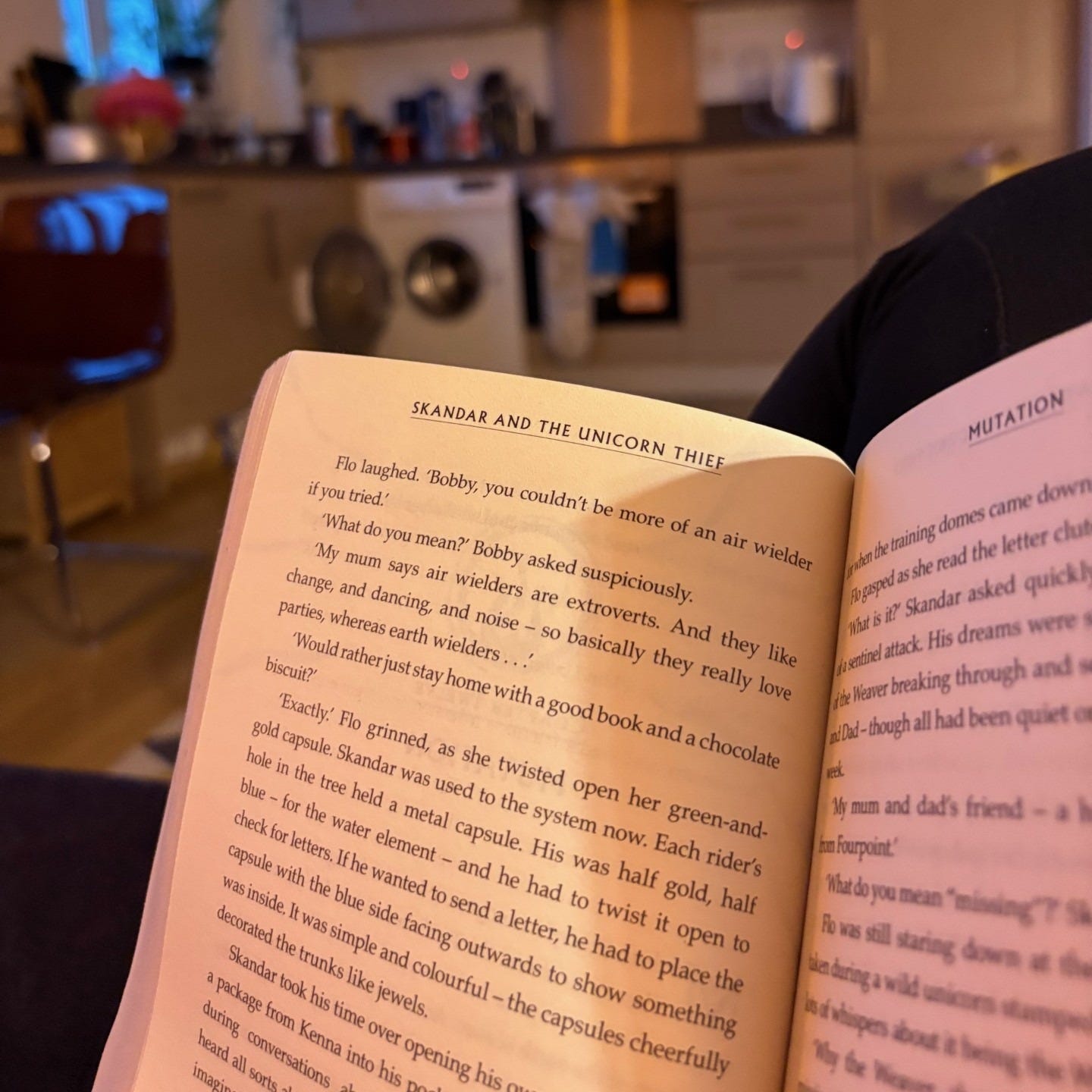
I recently picked up A.F. Steadman’s Skandar and the Unicorn Thief,6 the middle-grade series that is probably the closest thing to a Harry Potter competitor we’ve seen in the last decade. Skandar lives in a world where unicorns are real and, on your thirteenth birthday, you are given the opportunity to attempt to bond with a unicorn of your own. These aren’t cute fluffy unicorns, oh no, but bloodthirsty, carnivorous beasts that require taming through hard graft at the Eyrie, the magical school of this series. This is actually, not the most derivative idea on its own, and I can’t say that the novel is badly written. The feature I take a little more issue with is that, once you have your unicorn, you must find out what element you are allied with. There are four elements. Three guesses. You got it — Earth, Water, Fire and Air. This is of course, determined by a lengthy sorting sequence, by the end of which you realise you’re halfway through the book already. In my personal view, these kinds of sorting ceremonies have an absolute dreariness much akin to being told at length about someone else’s dreams.
As in other books of the kind, the element you are associated with says something about you as a person:
Flo laughed. ‘Bobby, you couldn’t be more of an air wielder if you tried.’
‘What do you mean?’ Bobby asked suspiciously. ‘My mum says air wielders are extroverts. And they like change, and dancing, and noise — so basically they really love parties, whereas earth wielders…’
‘Would rather just stay home with a good book and a chocolate biscuit?’
There is absolutely nothing original about Steadman’s sorting premise. It fundamentally scratches the itch that the others do, with the double whammy of its predictable four-element division. Let me guess, fire wielders are hot headed? In children’s fantasy, characters rarely chafe against the house system in the school, usually finding it a convenient way of creating an illusion of belonging and in-group, out-group conflict.7
The Divergent trilogy by Veronica Roth is oft-mocked for being derivative. coming hot on the heels of a flurry of other dystopian YA novels. These books are, somehow, the offspring of The Hunger Games trilogy, which notably does not utilise the sorting ceremony trope (it does use a selection ceremony, which is admittedly similar). The society of The Hunger Games, Panem, is not sorted into factions, but districts, dividing people along class lines instead of, I don’t know, the content of their hearts and minds. The Hunger Games is overall a much more gutsy endeavour politically and I maintain that it is actually very good. Its horrifying brood, however, does leave a bit to be desired. The difference between fantasy sorting and dystopia sorting, is that usually the sorting system is the source of the conflict in the latter.
In Divergent, our hero, Tris, is a teenage girl on her way to be sorted into one of five factions: Abnegation, the faction she has grown up in, Amity, Erudite, Dauntless, and Candor. I’m sure I don’t have to explain the factions; they do what they say on the tin. The day of her sorting, Tris finds out she is Divergent, not clearly fitting into one faction’s selected character traits. She must choose between three factions, her family in Abnegation, Erudite, or the reckless, thrill-seeking Dauntless. If she does not choose, she could become one of the underclass ‘Factionless’ who live on the streets of post-apocalyptic Chicago. She chooses Dauntless, obviously. The remainder of the series becomes about resisting this kind of easy categorisation, a revolution centred around toppling the Faction system. Regardless of the ultimate message of this series — that people are not so easily boxed in — the draw of this categorisation is irresistible to young people. It can’t help but undercut the message the author is trying to put across. I’m sure at some point I would have told you I was an Erudite, even though I knew that in their heart of hearts, everyone is unique, everyone is Divergent.8
Whether or not this world-building is patently preposterous is unimportant to the teenage reader. I ate this kind of thing up at age fifteen, desperate to find another identifier to attach to my build-your-own-identity keychain. As an adolescent, you are absolutely desperate for someone to tell you who you are and who you should be, so this kind of easy designation is catnip for teenagers.9 It sells. I think, on a case-by-case basis, its fairly harmless fun, but if we take a step back to look at this phenomenon as a whole, a less rosy picture starts to emerge.
In her pamphlet ‘Why You Should Read Children’s Books, Even Though You Are So Old and Wise,’ Katherine Rundell writes:10
…what I try for when I write — failing often, but trying — is to put down in as few words as I can the things that I most urgently and desperately want children to know and adults to remember.
I like this attitude — it’s a way of articulating the value of children’s literature without leaning too heavily into the didactic. Didacticism should not, in my opinion, be a focus of literature aimed at children, particularly teenagers. They resent anything that could be read as patronisation or condescension. However, I think it is worth considering what it is we most urgently and desperately want children to know and adults to remember when we commission yet another boarding school fantasy with a personality-trait based sorting system.
In the early to mid-noughties, Tumblr was the site where all of this YA-identity building built its roost. There is a notorious post where all the fandoms are called upon to defend the sanctity of tumblr, starting with ‘Potterheads, grab your wands!’ This post is now considered the urtext of millennial cringe and what I think it demonstrates really well are the ways in which ideas of justice became tied up in fandom-based identity building. Before there was ‘woke’, there were Social Justice Warriors, people who believed strongly, and well-meaningly, in progressive social politics — LGBTQ+ rights, accessibility, intersectionality and the right to choose . I would probably have been categorised thusly at the time. It was common for the bios of so-called SJWs to contain a number of fandom and faction identifiers — your Hogwarts house, at least, was a must. Cringe though it might have been, I feel a great deal of tenderness for this time. This was a movement, made up almost entirely of children, which earnestly wanted inclusion for all. It was relentlessly demonised by grown adults in the press and now years down the line, has been absorbed into existing ideas of the left as being lily-livered.
Things have changed since then. The political rift between right and left has deepened further since the early 2010s, the tone of discourse rising to a fever pitch across the political spectrum. In the UK, polls are showing that the top two political parties are the Greens and Reform UK, which sit to the left and right of the usual powerhouses of Labour and the Conservatives. On the left, progress is continually undermined by infighting and internal demands for perfection. I personally suspect that Moral Scrupulosity OCD might be the focus of a lot of mental health chat this year. This diagnosis, which has historically been mostly attributed to religious obsession, is a subtype of OCD wherein the patient is preoccupied by the morality of their actions, whether or not they’re a good person. With discourse around politics encouraging you to cut out those with a difference of opinion,11 I would not be surprised to find that this is on the rise.
I think the societal level of despair we are constantly feeling these days can be at least partially attributed to a misplaced belief in the immutability of character. We believe that people are, fundamentally, who they are. We believe that people who do wrong will inevitably repeat that wrong. We believe in our own impotency to do anything about the current state of affairs. I don’t know about you, but I have definitely changed. I certainly hold different political beliefs, some more radical, some more nuanced than when I was posting on Tumblr at eighteen years old. I’ve written at length around how transformative discovering swimming was for me last year in terms of changing my perception of myself. I had a friend of mine recently express surprise that she was hit on by an old classmate of ours at a bar — ‘But Ellen, we were geeks.’ She said this as if school didn’t finish for us almost twelve years ago now, but I understood what she was getting at. Identities are, for sure, sticky things — I think improving our awareness of the assumptions me make about ourselves subconsciously is transformative. I think if we want the next generation to be able to smooth over the deep furrows in the political landscape, they’re going to need to be able to see mutability as a possible thing.
Returning to house sorting in children’s lit. The message urgently communicated in these novels is one of belonging — the idea that, even if you can’t find your people now, they are out there for you somewhere, they are here right now in this book. This is not invaluable, certainly wasn’t invaluable for me as a child. However, going into adulthood, it definitely encouraged me to treat people with suspicion. I was a Ravenclaw, cleverer than you and as soon as I could get out of this damn school, I would show you all! People would see, clearly, that I was a nerd, and continue to treat me with the same social disregard as they did at age thirteen.12 In my cruellest moments of self-deprecation, I always think of the school reunion episode of 30 Rock where Liz, imagining herself to have been the downtrodden social outcast, is actually revealed to have been unnecessarily cruel to those above her in the social pecking order.
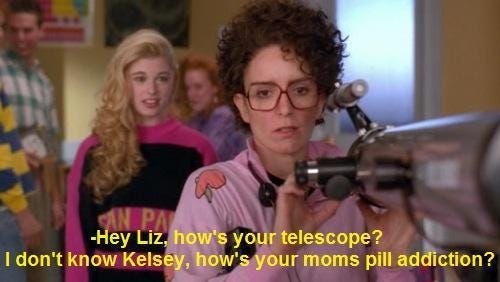
I hope, earnestly, I was never this bad. However, I was probably suspicious of people with no malicious motive and I imagine that came across. Apologies, classmates, if you’re out there.
Maybe, maybe, I’m taking this whole thing too far. Maybe these identities are a life raft for those who socialising and fitting in doesn’t come naturally. I have to wonder, however, if having an entire literature dedicated to baking in the idea that people are easily categorised is the message we really want children to take on board. The characters in these novels often resist development, coming out of the other side roughed up and surely traumatised, but fundamentally still the people they were in the novel’s first chapter, just maybe a little more confident with it.
If I had a message that I most urgently and desperately want children to know and adults to remember it would be that very little about you is immutable and fixed, unless you choose to make it so. If you choose to identify strongly with your academic intelligence, you may have that identity forcibly unmoored by discovering that intelligence has very little value on its own, and that you also need hard work and people skills to transform it into success. If you choose to identify with your physical prowess, you could have your identity ripped apart in seconds by an ACL tear. If your moral value system is rigid and fixed, you have to be prepared for the possibility that this will end longstanding friendships, and that, even if you truly believe yourself to be in the right, this is going to hurt regardless. If you believe yourself to have innately unimpeachable morals and those who don’t to have a fundamental character flaw, you will shock yourself immeasurably when it turns out that you, too, are capable of hurting others. If you believe yourself, Earth wielder, to be fundamentally introverted, you’re going to miss out on the whole party.
I’d like to see more children’s protagonists forced to reckon with worlds that try to sort them into neat and comfortable categories. We can give these kids life-rafts, sure, but they need boats, boats they can feel comfortable Ship of Theseus-ing into adulthood as the waves hit them and break their preconceived notions apart. For the sake of positivity, here are a few children’s books I think do this really well:


Balls are commonplace at the University of St Andrews. As are minor European royalty and the landed gentry. Do the maths. Christmas Ball was actually less ostentatious than most of these events, and was run as a fundraiser to send shows to the Edinburgh Fringe.
The student newspaper frequently ran (probably still runs) think pieces about the ticket pricing and dubious optics of balls. One of my favourite out-of-touch St Andrews moments was when I spotted an alumni comment on one such post chastising the writer for complaining because they were ‘in for a shock about the cost of balls in real life.’ Balls, in real life. Oh, how the other half live.
What the Divergent movies lack in, well, quality, they make up for in absolutely bangin’ soundtracks.
My school’s houses were named after local parks, and participating in sports was the only way to accumulate house points. That was, as far as I was concerned, none of my business.
Children’s literature as we think about it now, as fiction written primarily with the child reader in mind, is not as old as we might think it would be. The Haunted Wood by Sam Leith is an interesting history on the subject, though it does have, I think, a very masculine, English outlook.
I was mortified, mortified, to be sorted into Hufflepuff on Pottermore after years of militant identification with Ravenclaw.
While we’re here, a little wild to me that a title so close to Percy Jackson and the Lightning Thief, and so clearly aimed at the same audience, made it to shelves without much scrutiny. A friend of mine pointed out that this might be an attempt to capitalise on parental confusion.
There is a secret fifth potential element in Skandar, which is a site of conflict in the book, but there’s very little questioning of the elemental allying, at least in the first book.
A precocious child. I’m aware.
There is a different kind of child-determined sorting that emerges from a different kind of school narrative - the chick flick clique. If you were at school in the late noughties, you might remember some class mates attempting to sort your year group into cliques a la Mean Girls — me and my pals were Mathletes. Go figure. St Trinians also leaned into this.
My queen, my angel, Katherine Rundell would NEVER sort kids into houses.
Let’s be clear, I do think the company that you keep says something about your character, but I think obsessive worrying about whether you should cut out that one friend who once said something a little off-colour about the dating habits of bisexuals is maybe not a useful focus for your political energy.
I remember being truly baffled when, at university, someone made a comment to me about how I wouldn’t understand what it was like to be bullied at school. Talking to a friend about this later, they pointed out that the way I came across as an adult didn’t give people the impression that I might have struggled socially at school. Extremely flattering, and a good demonstration of how our outward presentation might change long before we actually assimilate the change into our identities.
As a teen I, genuinely upset and ashamed, told a school therapist that i didn't get sorted into ravenclaw on pottermore and to this day i remember her giving me the most withering 'Grow up, you can't just be one thing' talk of all time. it truly snapped me out of the chokehold sorting narratives had me in
I've always thought of Hogwarts houses as sort of Millennial horoscopes. While I heartily agree with your sentiment that we shouldn't box anyone in, least of all children, we see it time and time again that people quite desperately want to categorise themselves as well as others. "It didn't work out because I'm an Aries/Hufflepuff and he's a Virgo/Ravenclaw..." I guess it's one way of making things simple in this mad world.